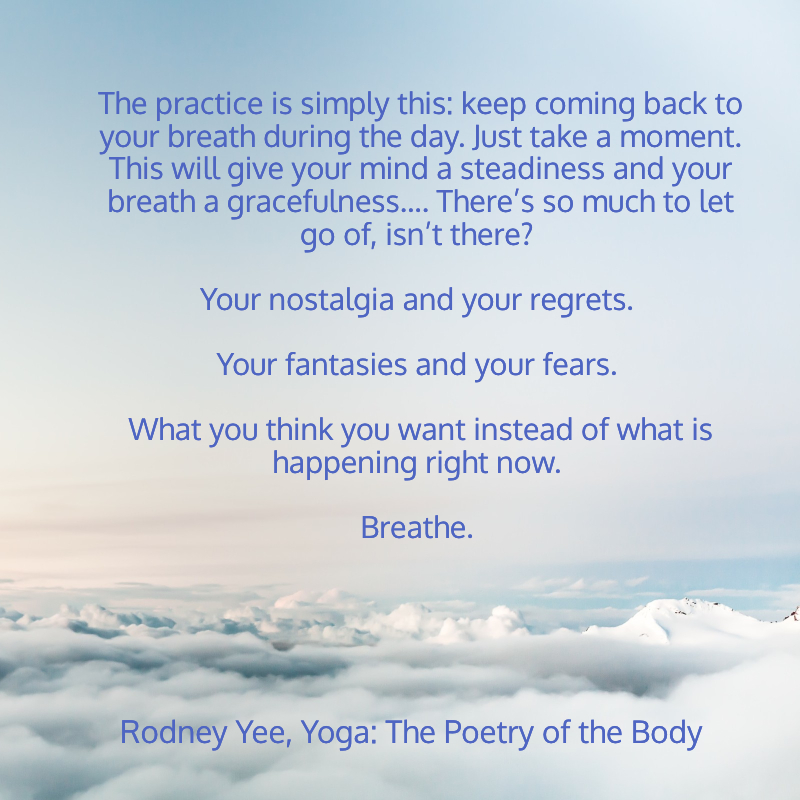
Week 29/Return to Breath: The Five-Minute Breathing Space

Returning attention to the breath offers us a path home when our thoughts and emotions have carried us into the depth of the past or the unknown forest of the future. Sometimes it can simply be a way to bring what Tara Brach has coined, “a sacred pause”, stepping out of autopilot and reconnecting to what is, in this very moment. 
 
As human beings walking the path of life, we wish for things to be known and predictable.  If we are honest with ourselves, our deepest desires are for things to be ALL GOOD, yet this is not the nature of life. Rather, we are in a web of interconnected forces of positive and negative energies.  These energies will invariably result in all kinds of experiences, including pain and pleasure; joy and depression; love and fear.
 
Mindfulness training can help us discover equanimity -the ability to be centered and stable despite the changing landscape of experiences. Training in equanimity is similar to preparing for an Iron Man competition rather than a 5K. It requires years of practice, teachings, and an abundance of patience and non-judgment during difficult moments that will test your composure. Developing an anchor to help steady you during the storms of life is one essential tool for building equanimity. Daily formal practice helps to strengthen this connection and paves a short cut that makes returning to it in difficult times much swifter, lending a hand to rebalancing when life side swipes us. 

Another helpful tool to carry with you on the journey of life is the Five-Minute Breathing Space , which can be utilized either at the beginning of formal meditation, as a brief midday meditation, or in a moment of distress.
 
The Five-Minute Breathing Space (adapted from the Three-Minute Breathing Space found in The Mindful Way Through Depression) is simple 3-step exercise to help you return to your center.
 
STEP 1. BECOMING AWARE
 
Begin by deliberately adopting an erect and dignified posture, whether you are sitting or standing.  If possible, close your eyes.  Then, brining your awareness to your inner experience, ask: What is my experience right now?

  • What thoughts are going through the mind?  As best you can, acknowledging thoughts as mental events, perhaps putting them into words.
  • What feelings are here? Turning toward any sense of emotional discomfort or unpleasant feelings, acknowledging their presence.
  • What body sensations are here right now? Perhaps quickly scanning the body to pick up any sensations of tightness or bracing.

 STEP 2. GATHERING
 
Then redirect your attention to focus on the physical sensations of the breath breathing itself.
 
Move in close to the sense of the breath in the belly…feeling the sensations of the belly wall expanding as the breath comes in…and falling back as the breath goes out.
 
Follow the breath all the way in and all the way out, using the breathing to anchor yourself in the present.
 
STEP 3. EXPANDING
 
Now expand the field of your awareness around your breathing so that, in addition to the sensations of the breath, it includes a sense of the body as a whole, your posture, and facial expression.
 
If you become aware of any sensations of discomfort, tension, or resistance, zero in on them by breathing into them on each in-breath and breathing out from them on each out-breath as you soften and open.  If you want to, you might say to yourself on the out-breath, “It’s okay…whatever it is, it’s already here: let me feel it.”
 
As best you can, bring this expanded awareness into the next moments of your day.
 
You can learn more about mindfulness training in the upcoming orientations at the Sacred Treehouse.  I am also including some suggested reading and a recording to help you on your path:
 

The Mindful Way Through Depression
 
The Mindful Path to Self-Compassion 
 
The Mindful Self-Compassion Workbook
 
Five-Minute Breath Recording:
Patty Thomas Shutt, founder of Sacred Treehouse, is a licensed psychologist and co-owner of Therapeutic Oasis of the Palm Beaches Dr. Shutt is passionate about helping others discover the benefits of mindfulness and meditation.  She offers Beginner Meditation & Advanced Meditation classes at Sacred Treehouse, in addition to Mindfulness Based Stress Reduction, Mindful Self-Compassion and various book studies throughout the year.
Week 28/Love is the Way

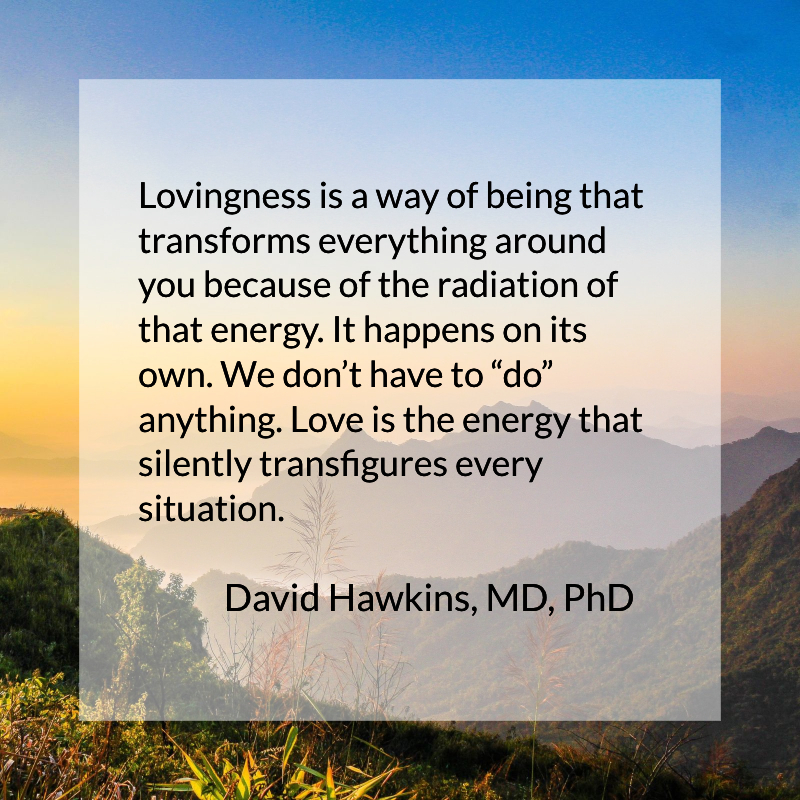
Our inner state affects how we view the world around us. Most of us have experienced seeing a person or circumstance from a place of negativity, then having something pop that bubble of negativity and suddenly we are more patient, tolerant or accepting—even though nothing has changed outside of ourselves.   The more open we are to see the world from the lens of Grace, i.e. that things are occurring the way they are for a higher reason, the more we can say “yes” to life’s events.   This allows us to be open and even grateful, and with that the more love emanates from us to others.  

People can sense what we are experiencing.  We’ve all had the experience of walking into a room and sensing that a fight had occurred. Conversely most of us have had days when our hearts were full of gladness and we ended up seeing the beauty around us and having wonderful exchanges with strangers and loved ones alike.  As Hawkins says, “we transcend the smaller aspects of ourselves by accepting and loving them. We see the ego as “limited,” not “bad.” 

Every day is an opportunity to practice accepting our foibles, our sticky old patterns and instead to see them as some of our limitations, not our “badness.” It is also a chance to do the same for others at home and work.  Both of these practices will strengthen the other, for we cannot give what we don’t have and so it matters deeply that we are loving, patient and kind with ourselves.  Let the energy of love build in yourself and watch it silently transform your life.

Photography by Ciro Coehlo

Anni Johnston, LMHC-S, BC-D/MT, CEDS, CYT works at Therapeutic Oasis of the Palm Beaches as a Licensed Mental Health Counselor and Movement Therapist.  In addition to her therapy work, Anni offers weekly Beginner and Advanced Meditation classes at Sacred Treehouse.  She also offers book studies and special workshops throughout the year.

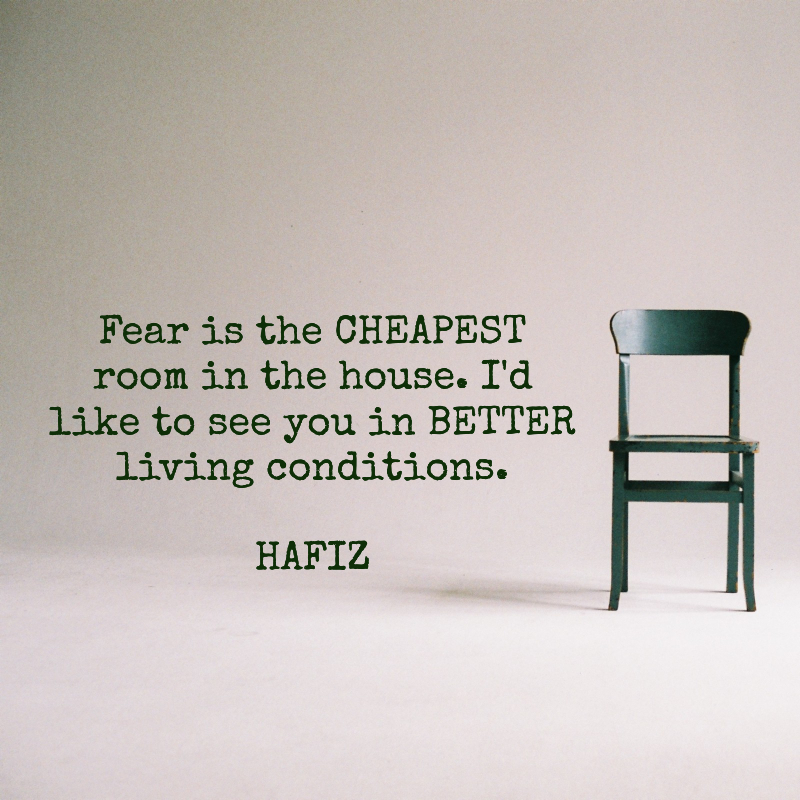
Week 27/What Room Do You Occupy?

Ridding ourselves from unnecessary fear is essential to living in peace. I wholeheartedly believe it is possible to discover peace while living in a world filled with so much destruction and strife. In my experience as both a therapist and mindfulness teacher, I have found that love is the antidote to fear and will swiftly raise anyone to the finest room in the house. Which room do you want to live in? You may believe that others control what room you will occupy and this belief is simply untrue. Even the most oppressed can gain inner freedom and joy through the power of love.

I find myself in different living conditions based on my daily habits and practice. When in alignment with my deepest intentions, fellow beings, and the Earth, I am living in a palace of peace. When mindful habits are moved down on the priority list and I allow the demands of others or my lower self to take control, I find myself in a dark, smelly basement feeling alone and afraid. By surrounding myself with likeminded people who illuminate the path back to the palace, I quickly find my way back. Once we experience the peace and freedom that the practice offers us, it is hard to remain in the basement for long.

In the past few months, those closest to me have witnessed me dwelling in the basement of fear and uncertainty. They have been impacted by the emotions flowing through me: fear, anger, and despair. For this, I am truly sorry. It is my hope to shed much love and light on them, helping to illuminate their paths. I am happy to say that I am out of the basement with the support and love of likeminded friends that also walk the path. Thanks, tribe!

It is unbelievable to think that we are now halfway through 2019. If you have been following “52 Weeks of Mindfulness” from the beginning of the year, now is a great time to look back at any intentions you created, as well as mindful living inspiration you have cultivated from this journey.

Have you set anything into motion? If not, why?

No need to judge harshly – simply note what has gotten in the way of your practice. If you have put your intentions into action, take time to note what is helping or supporting this change. If like me, you got side swiped and lost your groove, take time to hit refresh. Reset your intention, revise it, and get connected. You definitely deserve to experience better living conditions!

If you are local, visit us at our new location (definitely a palace). We have meditation, yoga, and mindful workshops to help you.

Our new palace:

851 Broken Sound Parkway NW
Suite 250
Boca Raton, FL 33487
(Located within Therapeutic Oasis)

Patty Thomas Shutt, founder of Sacred Treehouse, is a licensed psychologist and co-owner of Therapeutic Oasis of the Palm Beaches Dr. Shutt is passionate about helping others discover the benefits of mindfulness and meditation.  She offers Beginner Meditation & Advanced Meditation classes at Sacred Treehouse, in addition to Mindfulness Based Stress Reduction, Mindful Self-Compassion and various book studies throughout the year.
Week 26/The Magic of Art & Mindfulness

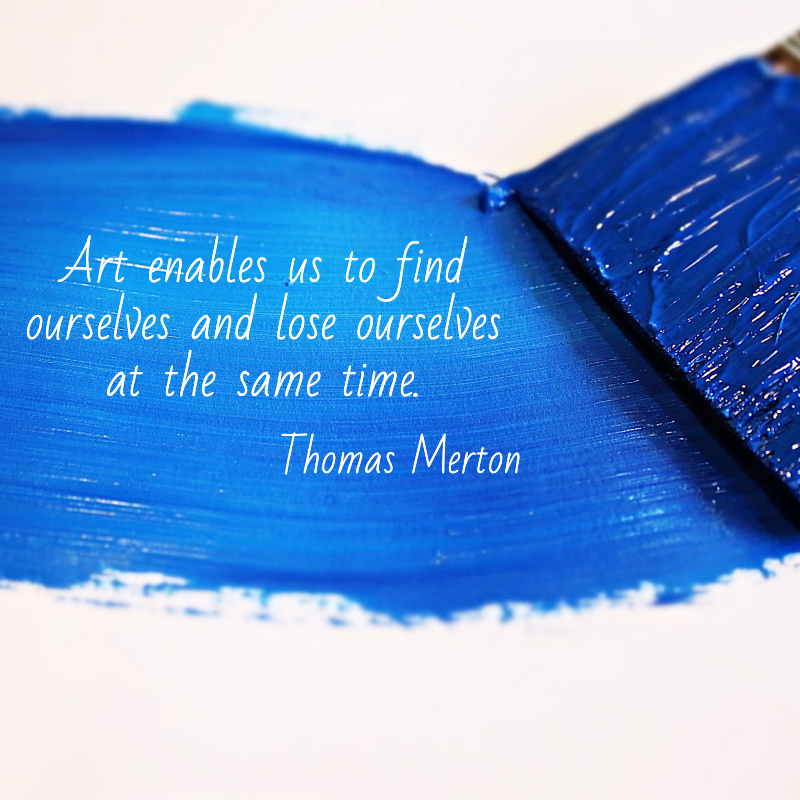
I recently invited one of my young clients into the art studio for some mindful art making. It was with excitement that he rummaged through a multitude of brushes and a variety of acrylic paints. With great care, he chose just the right tools for the job before settling into his chair and canvas. “This magic…I’m seeing it happen right before me”, I thought. He continued to work on his canvas, which would eventually become a piece that you would love if you only knew this client. The canvas and the painting it would become was not the magic I was witnessing. I know something far greater was happening. 

Art making is a powerful mindfulness practice, even if you are a self-proclaimed, “creatively challenged” individual. Research studies continue to explore the biological impact of creative expression. Resent studies noted that 30-45 minutes of art making, regardless of artistic ability, lowered participants’ cortisol levels (a hormone associated with our stress responses). This outcome is true across the life span, with children, teens, and adults reporting decreased sense of stress after participating in art. 

Like any one-pointed mindfulness practice, one thought (or two…maybe even twenty) can give way into our art making session. After some time, my young client, who had been so settled into his canvas gasped, “Oh no, I made a mess!” He realized that his creativity had spread off the canvas and onto the table. What an emergency that was for him! To this I replied, “Everything in this space is mess-able so that we can be creative.” With permission to be messy, just as he is, he continued into the flow. 

I invite you to get messy today!  Consider gifting yourself or your child the time and space for art making.  Even if you are “creatively challenged”, the experience itself is good for you.  To help you get started, check out these creative activities on Pinterest:

https://pin.it/t2sgmlnejv2s6c

Clara Bossie is a Licensed Marriage and Family Therapist at Therapeutic Oasis of the Palm Beaches In collaboration with Sacred Treehouse, Clara has developed a series of lectures, book studies and workshops designed to bring harmony to family life, including the popular True Love book study. When she is not busy creating, Clara also practices and teaches yoga.  

Week 25/The Power of Opposite Action

Is there someone in your life who consistently has a way of pushing your buttons?  Maybe more than one person? 

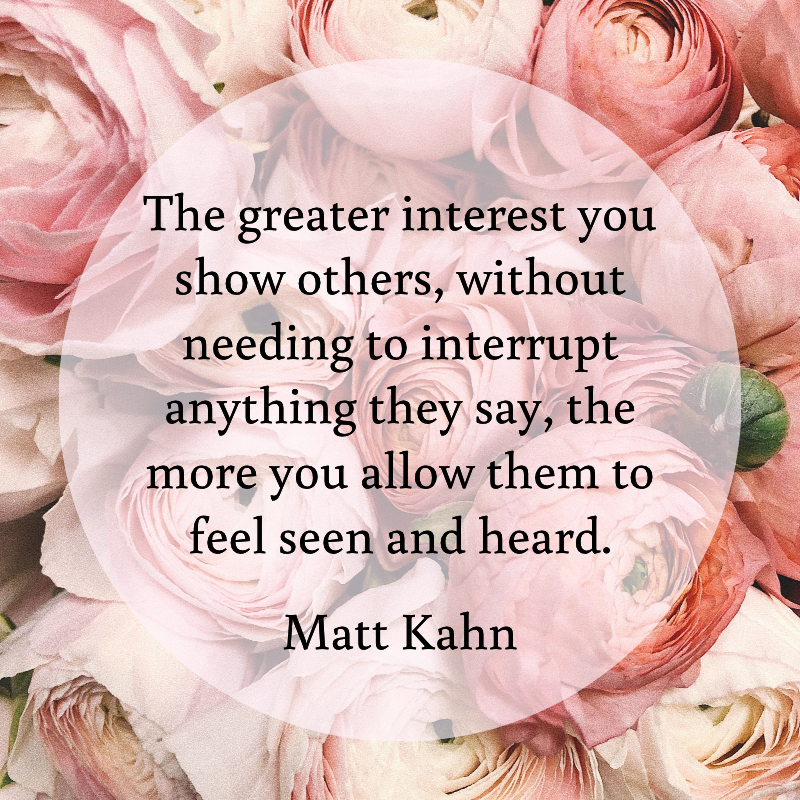
Could you imagine how different things could be if you just listened to them, really listened, and didn’t interrupt them.  

Matt Kahn describes the use of the Law of Polarity to help shift any troublesome relationship. He says instead of matching the energy of others,do the opposite. If they are yelling, you listen quietly. If they are agitated, you deliberately take long, slow breaths. If they are tense and rigid, you deliberately soften your body. If they complain, find ways to compliment.  This is a very powerful process- in fact, I’ve watched it melt away a moment of tension like deflating balloon. 

We have this incredible power within us; the power to shift any circumstance.  This doesn’t mean that we can have power over another; it means we can bringpositive  to any relationship—even when things are heated.  The more we do this, the more we realize we don’t need anyone else to act a certain way to feel peace, calm, and joy of life. Doing to opposite, avoiding the pull of conflict, requires practice and a clear decision to change your part of the equation. 

Kahn says by practicing this “…you come to notice every single character who enters your reality is an animated flash card for personal growth. Each of those personal encounters becomes an invitation to breath more slowly, speak more softly, and act more graciously as a way of coming into greater harmony with the light of your divinity. This allows you to feel safe in your body, not as a result of personal circumstances, but based on how compassionately your are willing to respond to the situations at hand.”

Photography by Ciro Coehlo

Anni Johnston, LMHC-S, BC-D/MT, CEDS, CYT works at Therapeutic Oasis of the Palm Beaches as a Licensed Mental Health Counselor and Movement Therapist.  In addition to her therapy work, Anni offers weekly Beginner and Advanced Meditation classes at Sacred Treehouse.  She also offers book studies and special workshops throughout the year.

Week 24/Using Yoga & Mindfulness to Improve Our Sleep

We often think about the practice of yoga as helping us manage stress and as an aid to greater self-awareness. Most commonly, when we think of yoga practices that aid us in those endeavors, we usually think of postures, breathing and meditation.

However, it’s easy to overlook the yoga practices of lifestyle that are simple, yet have profound effects. Those choices can actually help support our other yoga practices (and vice versa) by keeping our mental attitudes clear. Lifestyle changes help us create a fit instrument – body and mind – so that we can lead a healthy and joyful life, and deepen our self-transformation process.

Sleep provides deep rest for the body and the mind, but most of us either don’t sleep enough or, when we try to sleep, we are restless because our minds are full of thoughts and worries.

There is an old story:

Someone asked the Master, “How do you practice Zen?”
The master said, “When you are hungry, eat; when you are tired, sleep.”
“Isn’t that what everyone does anyway?”
The master replied, “No, No. Most people entertain a thousand desires when they eat and scheme over a thousand thoughts when they sleep.”

Try these suggestions for better sleep:

  • What time you eat and what you eat affect your sleep – try to eat a lighter dinner not too late in the evening.
  • 30 min -1 hour before bed, end your day by engaging in something relaxing and peaceful (Watching the TV doesn’t count.)
    • read, especially something inspiring
    • meditate (by candlelight is especially relaxing)
    • listen to soft music
    • take a bath
    • do some breathing that focuses on lengthening exhale
  • Try to go to bed around the same time every night (ideally before 11pm) and get a full 8 hours of sleep.
  • Try this gentle breathing and counting practice if you are having trouble falling asleep. I call it “1 to 5 and 5 to 1”.
    • IN=inhale and EX=exhale.
    • Allow the breath to be gentle in both directions keeping your mind gently focused on the flow of breath and the number you are counting. Remember the goal is to relax the body and mind and to fall asleep. So gently repeat it until you fall asleep or feel relaxed enough to do so. 
      • As you IN internally say 1
      • As you EX internally say 2
      • As you IN internally say 3
      • As you EX internally say 4
      • As you IN internally say 5
      • As you EX internally say 5
      • As you IN internally say 4
      • As you EX internally say 3
      • As you IN internally say 2
      • As you EX internally say 1


Yours, in service, K.O.

Kathy Ornish, c-IAYT

Kathy Ornish is a practicing and certified yoga therapist (c-IAYT) and a certified yoga teacher (E-RYT-500). She serves as Senior Faculty at Gary Kraftsow’s American Viniyoga Institute where she is Faculty Specialist in the Viniyoga Foundations Program for Teaching and Yoga Therapy. Kathy’s yoga therapy practice involves addressing individual’s structural, physiological, and emotional conditions. Her primary emphasis in all her teaching is the breadth of the yoga tradition using the appropriate application of the many tools of yoga in hopes that she can help people realize their highest potential.  For more information, please visit her website at www.goodspaceyoga.com.  She also offers workshops and individual services through Sacred Treehouse.

Week 23: Up, Up, & Away! Mindful Travel & Sightseeing

Summer has arrived and for many readers, this means travel plans, day trips, and sightseeing adventures are planned for the near future.  Traveling can bring out both the best and worst in all of us.  It’s always enriching to experience a new culture or destination, but it takes a lot of advanced preparation.  And once we have arrived, we may have to contend with language barriers, cultural differences, and navigating a new place. Putting all of the pieces together is simultaneously exciting and stressful. 
 
How can we ensure that we are a part of our journey rather than apart from it?

Before the Trip


Our minds are always planning and we may notice that we create “mind destinations” to go along with our itineraries.  We anticipate how our vacation will unfold and with this anticipation comes expectation.  Attachment to particular activities or timelines creates rigidity.  Mindfulness encourages open awareness, but once we develop attachment, we run the risk of disappointment.
 
Every step in your experience is important.  Flexibility and openness will allow for a fuller experience.  Don’t over plan activities.  Make sure to leave room in your itinerary for reflection, free time, or even impromptu activity changes. 

During the Trip

Between airports and long commutes to our destination, we may find ourselves grumpy and exhausted.  Mindfulness means listening to what your body really needs and practicing self-care.  Prepare in advance by packing self-care items important to you and make sure to stick to healthy routines:

  • Avoid heavy meals before big travel days
  • Pack your favorite snacks
  • Stay hydrated
  • Bring comfortable clothing and shoes

Once you have arrived at your destination, practice mindfulness in the moment during exploration. After all, it took a lot of work to get to this point!  Smartphones allow us to capture special moments, but also serve as distractions.  Make it a point to experience the environment and culture through your own eyes, instead of through the lens of your phone.  Tips for remaining present and still bring home moments to share with friends include:

  • Allow yourself to snap in the beginning of the activity and learn to refrain from pulling out your phone for every single monkey, bird, or meal.
  • Look out the window – not down at your screen! Edit and upload your photos when you return to the hotel, or better yet, when you return home.
  • Engage in conversations with fellow travelers.  On long commutes, listen to feel-good music or mind-expanding podcasts.
  • Journal about your travels.
  • Bring a book and consider gifting it to another on your journey.

They say a picture is worth a thousand words, but if you aren’t fully present, do you think you could achieve that word count?
 
Even if you plan to explore locally this summer, I recommend incorporating mindfulness into your experience.  We all need vacations and breaks from the norm.  Our brains grow from exposure to novelty.  Whatever your plans are this summer, take time to mindfully step away from the daily grind.
 
Happy travels!
 
Lizzie

Photo credit: Lizzie Shutt

Elizabeth “Lizzie” Shutt is a student at the University of Florida.  She is passionate about all things green and currently participates in many forms of environmental advocacy, including the #Unlitter movement.  When she isn’t hitting the books, she enjoys cooking plant-based cuisine, composting, and surfing.

Week 22/ What Holds Your Attention?

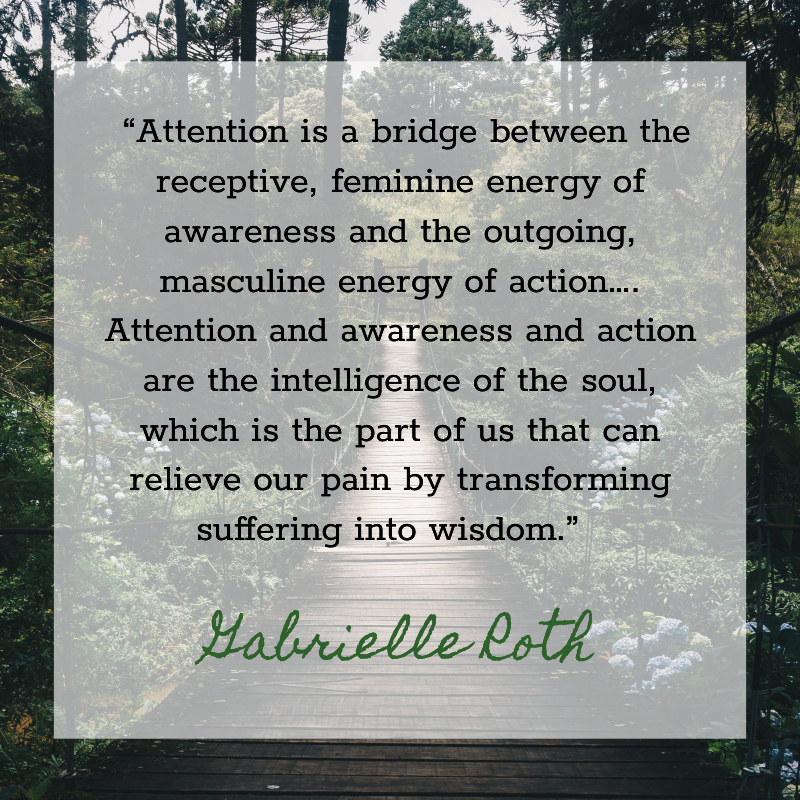
Take a moment and contemplate the last time you just stopped.  You weren’t checking email, texts, watching TV, doing bills or errands… you were just resting.  Our culture is concerned with “what we do (for a living),” “what we did (on the weekend),” or “what was done (at work).”  But this constant striving, outputting of energy is costing us all. We are tense with our children and spouses, we are short with co-workers, or unable to appreciate our friendships because our “to do” lists seem to be constantly knocking on our inner doors.  This keeps us out of balance.
 
The masculine energy of action (both men and women have this) is a wonderful driver, but the feminine energy (yes men have this too) of being and receiving is an essential counterpoint to all the doing.  When I’m on silent retreat, sometimes for 10 or more days, I find in the first few days my mind and nervous system seem to be unspooling from daily life- despite daily yoga and meditation. Not everyone is inclined or able to do long retreats, but everyone can take a day for rest.  The tradition of the Sabbath was to pull us away from our constant doing, to rest and contemplate those things beyond daily life.  A day of rest, even if not done weekly can refresh your Soul and help to put things in perspective. As the old saying goes, “no one wishes on their death bed they’d put more hours in at the job.“ 
 
What we wish for is we’d taken more opportunities to explore, attended to the little moments of sweetness along the way, and had given and received more love.  On a Soul level we know this to be true but our mind is always pushing.  Try on a few hours of just resting.  Completely unplug and either alone or with someone dear to you just stop, listen and notice what is right in front of you.  As William Blake says:
                    

“To see a world in a grain of sand,
And a heaven in a wild flower,
Hold infinity in the palm of your hand,
An eternity in an hour.”

Photography by Ciro Coehlo

Anni Johnston, LMHC-S, BC-D/MT, CEDS, CYT works at Therapeutic Oasis of the Palm Beaches as a Licensed Mental Health Counselor and Movement Therapist.  In addition to her therapy work, Anni offers weekly Beginner and Advanced Meditation classes at Sacred Treehouse.  She also offers book studies and special workshops throughout the year.

Week 21/Ride the Wave

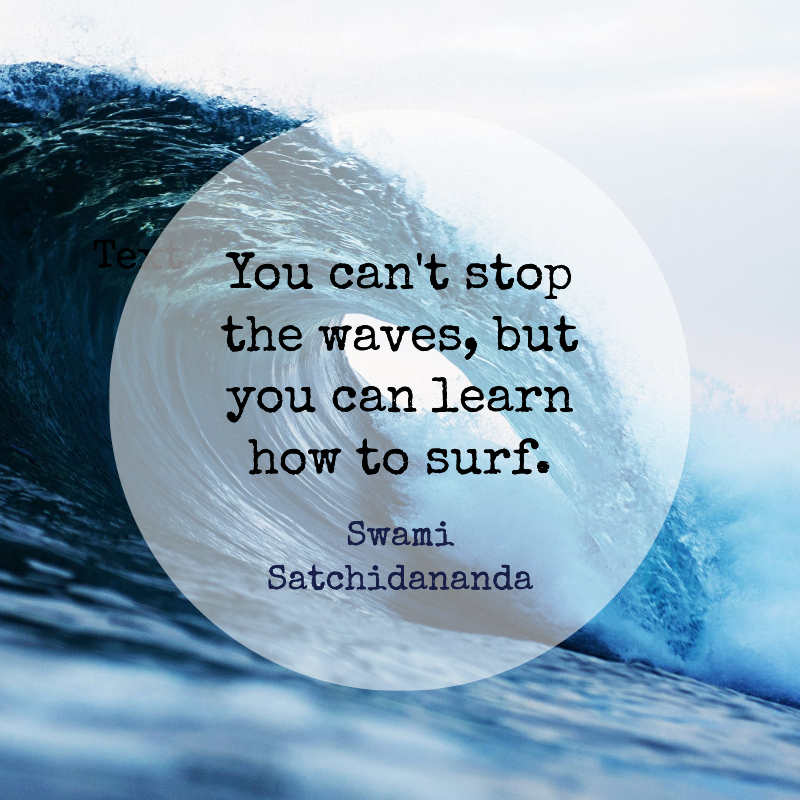
How many times have you felt battered by the waves?  We often find ourselves struggling in that metaphorical sea of waves – strong emotions, unexpected events, illness, and difficult relationships.  They ebb and flow just like the waves of the sea.  And just like a surfer in the ocean, we try to navigate them skillfully.  We try to keep our heads above water.

In our minds, we expect to be expert navigators right from the beginning.  What many of us fail to realize is that it takes years of practice to build the skills needed to manage our emotions and the external events that life throws at us. As a Mindfulness-based psychotherapist trained in Dialectical Behavior Therapy, I wholeheartedly embrace this quote, yet at times it seems impossible to achieve.

Just as a surf instructor would not send a beginner out into a 10-foot swell, I would also not expect a novice mindfulness student to stay centered in the midst of an emotional storm. Even the most expert teachers lose their balance and get torn up by the coral reef of real life. There is real risk involved in surfing the waves of emotion, including the significant risk of feeling pain and discomfort. No one pops up on a monster wave, staying upright and focused, without significant training. And sadly, this is where the metaphor ends. We can opt out of the ocean if surfing doesn’t appeal to us, but we cannot opt out of our emotions without serious consequences. 

Do you want to learn how to surf the emotional waves of life? If yes, start small and experiment with the following WAVE:

Welcome: Welcome feelings and reactions; allow yourself to open to sensations, thoughts, and urges without acting.

Attend: By giving full attention to this experience moment to moment, not reliving the past or fortune telling the future. Stay present with the full experience by naming and describing what is happening inside the body and mind.

Validate: Identify the truth in your experience (not the absolute truth!) by understanding the thoughts, beliefs, and physiological prompts that resulted in the emotion arising.

Exhale: Let go of the energy created by the emotion, or any resistance of feeling the emotion. Allow the body to soften and settle with exactly what is happening in the present moment.

To become a skillful surfer of emotions, repeat the WAVE over and over. With practice, you will grow stronger and more skillful, enjoying some of the grace and freedom that comes from surfing the big waves.

WARNING: START SMALL. If you find that you are struggling, seek out an instructor (therapist, mindfulness teacher, sponsor, or loved one) to help you conquer the monster waves.  Expect to wipe out, but also be sure to pop back up.

Patty Thomas Shutt, founder of Sacred Treehouse, is a licensed psychologist and co-owner of Therapeutic Oasis of the Palm Beaches Dr. Shutt is passionate about helping others discover the benefits of mindfulness and meditation.  She offers Beginner Meditation & Advanced Meditation classes at Sacred Treehouse, in addition to Mindfulness Based Stress Reduction, Mindful Self-Compassion and various book studies throughout the year.
Week 20/Interconnectedness: My Soul Recognizes Your Soul

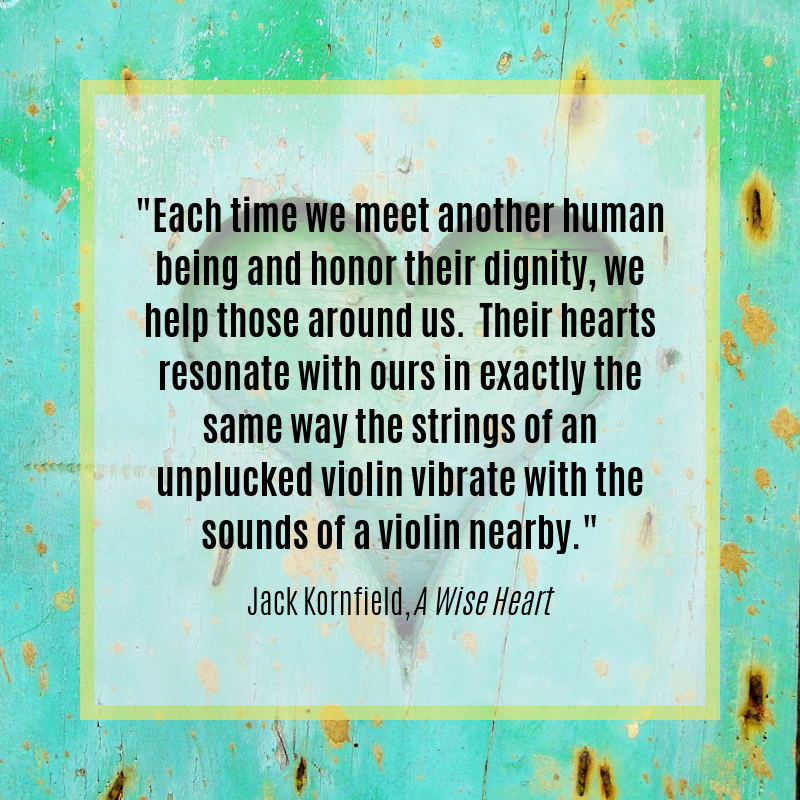
Jack Kornfield, a teacher and author in the Vipassana movement, acknowledges in the above-mentioned quote a phenomenon called “limbic resonance”, a state in which two mammals become attuned to each other’s emotional states.  Modern neuroscience and the neurobiology of attachment are beginning to uncover the importance of interconnectedness. Combined with psychology, we now know the ancient practice of mindfulness combined with loving awareness has the ability to enhance not only our wellbeing, but also that of our fellow human.

We all have a need to be seen and cared about without threat or judgment. In fact, this need is critical to developing a sense of safety in relationships, as well as a sense of belonging and being loved. We are seeing record numbers of individuals suffering from depression and anxiety. As a therapist and mindfulness practitioner, I feel both deeply concerned and committed to understanding the causes of this profound sadness. A sense of separateness or alienation from other living beings is often at the root of this deepest form of human suffering. Despite the wisdom of unity, that all beings are connected, (even modern quantum physics is confirming this as truth), many people carry a felt sense of disconnection and loneliness.

For those that do not struggle with this particular issue, I invite you to acknowledge that others do feel this way.  Using our compassion and understanding, we can validate the experience of another that is suffering.  We can actually see their suffering, acknowledge that we see it and sense how it is the same suffering that all humans feel if they are abandoned, chronically lonely, or feel unloved and unseen.  When we take time to see others completely, just as they are, we are offering our love and compassion. This offering vibrates in the hearts of others (similar to the violin in the quote) and creates a sense connection. This offers a glimpse of hope.

For those who do feel profoundly disconnected, lonely, or unloved, there is a path of freedom from this suffering. Although it may not be visible from your current vantage point, if you begin to take small mindful steps in your daily life, you will begin to feel some hope. This felt sense of hope is not freedom, but encouragement to take up the path of daily practice.

A teacher once taught that our paths are all littered with the debris of being human. Some piles are enormous and obscure the truth, also known as the path. These piles take great effort and help to clear.  This initial clearing can come in many forms, including psychotherapy, spiritual devotion, and meditation training. Sadly, one can live a lifetime under piles of rubbish, blinded from seeing the signs all around them pointing to this perennial truth:

We are all connected. If the pile feels too big, too much, or impossible, just take the first step and get help and support.

Patty Thomas Shutt, founder of Sacred Treehouse, is a licensed psychologist and co-owner of Therapeutic Oasis of the Palm Beaches Dr. Shutt is passionate about helping others discover the benefits of mindfulness and meditation.  She offers Beginner Meditation & Advanced Meditation classes at Sacred Treehouse, in addition to Mindfulness Based Stress Reduction, Mindful Self-Compassion and various book studies throughout the year.